Blog
Orbi vs Eero: Which Premium Mesh System is Actually Worth the Price?
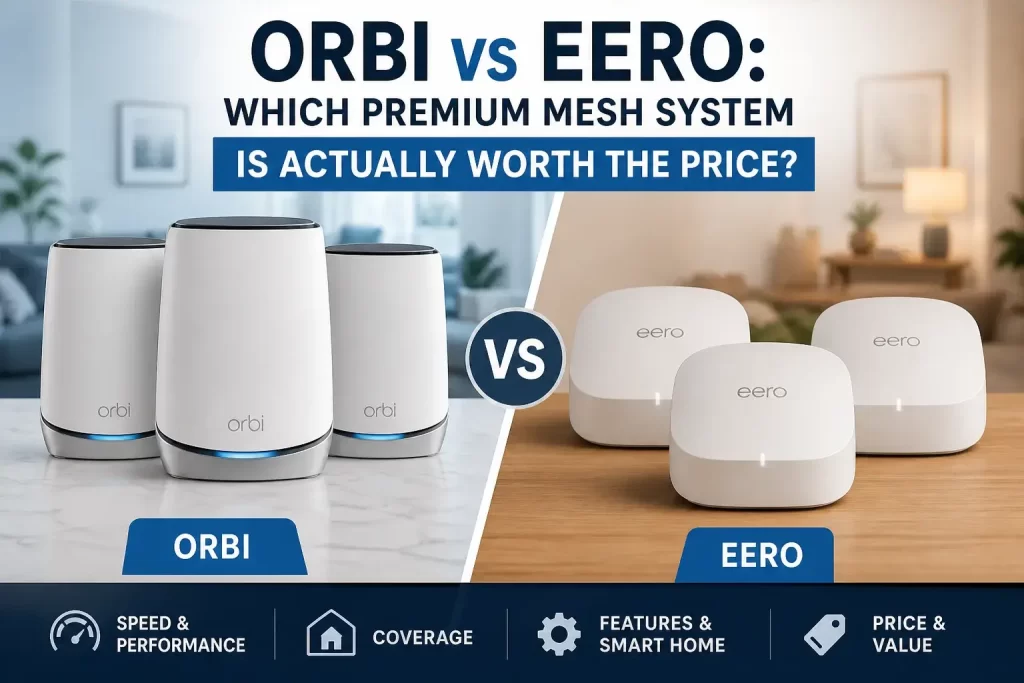
If you have ever struggled with slow internet in one room and perfect speed in another, then you already know how frustrating traditional routers can be. This is exactly where a mesh WiFi system helps you. In this detailed blog on Orbi vs Eero, you will get to know everything in a simple and practical way so you can actually understand which one is worth your money.
Both Orbi and Eero promise you strong, stable, and fast internet across your entire home. But the truth is, they are built for very different types of users, as one focuses more on power and control, while the other focuses on simplicity and ease. In this blog, we will go step by step and figure out which one actually makes sense for you.
Let’s start with the basics first…
What is a Mesh WiFi System & Why Does it Matter?
Before jumping into Orbi vs Eero, you must know what a mesh WiFi system is and what a mesh system really does.
A mesh WiFi system uses multiple devices (called nodes or satellites) placed around your home. Instead of one router trying to cover everything, these nodes work together to create one seamless network.
Which means:
- There will be no dead zones.
- You will get better speed in every room.
- There is smooth switching between nodes.
A mesh WiFi system is especially useful to you if:
- Your home is large
- You have multiple floors
- You use many devices at the same time
Once you experience a good mesh system, going back to a single router will feel like a downgrade.
Now, let’s talk about Orbi vs Eero…
What is Orbi?
Orbi is a premium mesh WiFi system that is designed mainly for performance and power. It is built for stronger speed and better coverage, especially if you have a bigger home or use the internet a lot.
Orbi is known for:
- Strong signal range
- High speeds
- Advanced networking features
In simple words, Orbi is built for people who want the best performance possible and don’t mind spending extra or tweaking settings.
A simple Orbi setup includes:
- One main router
- One or more satellites
These satellites communicate using a dedicated backhaul band, which helps maintain high speed even across long distances. That is why Orbi is often recommended for:
- Large homes.
- Gaming setups.
- Heavy streaming.
- Smart homes with many devices.
What is Eero?
Eero is completely different if you compare it to Orbi. It is made for people who just want their WiFi to work without any hassle. You don’t need to deal with settings or technical stuff; everything is simple and handled through the app.
Eero focuses on:
- Simplicity.
- Easy setup.
- Stable everyday performance.
Eero is designed for people who don’t want to deal with technical settings and just want WiFi that works.
Setting up Eero is extremely simple. You just have to:
- First, plug in the devices.
- Then, open the Eero app.
- Lastly, follow the steps, and within minutes, your network is ready.
Eero is ideal for:
- Small apartments.
- Small to medium homes.
- Small families.
- Work-from-home setups.
It may not always deliver you the highest raw speed as Orbi, but it provides very consistent and reliable performance.
Orbi vs Eero Comparison: What Makes them Different?
Before we get into the details of the Orbi vs Eero comparison, knowing what makes them different will help you to understand one simple thing: Both Orbi and Eero are made to fix your WiFi and give you better coverage at home, but they do it in slightly different ways.

One is more focused on power and advanced features, while the other keeps things simple and easy to use for you. In the sections below, we’ll go through each part step by step so you can clearly see which one feels right for your needs.
So let’s begin Orbi vs Eero war…
1. Setup and ease of use
This is one of the biggest differences between the two. It depends on whether you want a simple setup or a setup that you can customize.
– Eero setup experience:
- The Eero setup is probably one of the easiest mesh systems to set up.
- In Eero, everything is controlled through the app.
- You don’t need any technical knowledge for the Eero setup.
- It has automatic updates and optimization.
You basically have to just install it and forget about it, which makes it perfect for beginners or anyone who just wants hassle-free WiFi.
– Orbi setup experience:
- Orbi setup is not difficult, but it is more involved.
- Takes more time than Eero.
- Includes a web interface for advanced settings.
- Offers more control.
If you like customizing your network, then Orbi gives you that flexibility, but if you just want something simple, it may feel a bit extra to you.
2. Performance and speed
This is the difference where things get interesting. Speed and stability both matter, especially if you use the internet heavily every day.
– Orbi performance:
- Orbi usually wins in raw speed and power.
- It is dedicated to backhaul performance.
- It is better for long-distance coverage.
- It gives strong performance with many devices.
- It is especially good for gaming, 4K and 8K streaming, and large file downloads.
– Eero performance:
- Eero focuses more on stability than maximum speed.
- It has a smooth and consistent connection.
- It provides smart traffic management.
- It is reliable for everyday use.
- You may not get the highest speeds, but you will get fewer drops and interruptions.
3. Coverage and range comparison
Both mesh systems offer excellent coverage, but they handle it differently. The difference becomes more noticeable in larger homes or multi-floor setups.
– Orbi coverage:
- Has stronger signal per node.
- Covers larger areas with fewer units.
- Is better for big houses.
– Eero coverage:
- Is slightly smaller range per unit.
- Requires more nodes for large spaces.
- Better for compact layouts.
If you have a very large home, then Orbi usually needs fewer devices.
4. Design and hardware differences
This may not seem important to you, but this difference does affect how your setup looks and works in daily use. Size and ports can make a real difference depending on your needs.
– Orbi design:
- Is made for Larger devices.
- Has more Ethernet ports.
- Is built for performance.
- Good for users who:
- Have wired devices.
- Need multiple ports.
– Eero design:
- Is compact and minimal.
- Has only 2 Ethernet ports per node.
- Can blend easily into your home decor.
- Better for users who want:
- Clean setups
- Minimal wiring
5. Advanced features and control
This is where Orbi clearly stands out. The level of control completely depends on how much you want to customize your network settings.
– Orbi features provide:
- Advanced network settings.
- QoS (Quality of Service).
- VPN support.
- VLAN configuration is perfect for tech-savvy users.
– Eero features provide:
- Simple controls via the Eero app.
- Automatic optimization.
- Smart home integration options.
- Alexa integration.
- Matter and smart home standards, but it lacks deeper customization options.
6. Pricing and value for money
Both are premium mesh WiFi systems, but their pricing differs. Your choice depends on whether you want maximum performance or better overall value.
– Orbi pricing:
- It is more expensive.
- It has a higher upfront cost.
- It needs extra subscriptions for security features.
– Eero pricing:
- It is more affordable.
- It has better entry-level pricing.
- It need ptional subscription for extra features.
If budget matters, then Eero is easier to start with.
Which one fits your home better and your usage style better?
Choosing between Orbi vs Eero becomes much easier when you think about how you actually use your internet every day. Instead of focusing only on specifications, it will help you to match each system with your home’s size, usage habits, and comfort with technology.
Some users need high performance and control, while others just want a stable WiFi that works without any effort. That’s where this simple breakdown can help you decide quickly what you exactly want.
You can choose Orbi if:
- You have a large house.
- You need maximum speed.
- You are into gaming or streaming.
- You want advanced control.
You can choose Eero if:
- You want a simple setup.
- You live in a simple or medium home.
- You prefer stability over raw speed.
- You don’t want to manage technical settings.
Orbi vs Eero pros and cons: What you actually get?
Before making a final decision, this will help you to look at both the strengths and the limitations of each system. These pros and cons will give you a clearer idea of what you are paying for and what you might miss out on depending on your choice.
Orbi pros:
- It has a very fast speed
- It has an excellent range.
- It has more Ethernet ports.
- It provides more advanced features.
Orbi cons:
- It is expensive.
- It is complex for beginners.
- It is large in size.
Eero Pros:
- It has an extremely easy setup.
- It gives you a more stable performance.
- It has a compact design.
- It is good for everyday use.
Eero Cons:
- It has fewer advanced settings.
- It has limited ports.
- It has slightly lower peak speeds.
Final Verdict: Orbi vs Eero – Which One is Worth It?
When it comes to Orbi vs Eero, there is no one size that fits all answer. If you want the best performance, strongest signal, and full control over the network, then the Orbi is worth the price.
If you want something simple, reliable, and easy to use without dealing with technical stuff, then Eero is the better choice.
In simple words,
- Orbi: Gives more power and performance.
- Eero: Gives you simplicity and stability.
The right choice depends on your home size, usage, and comfort level with technology.
Frequently Asked Questions
Q1: Is Orbi better than Eero for larger homes?
Ans: Yes, Orbi is generally better for larger homes than Eero because it offers a stronger range and higher performance with fewer nodes.
Q2: Is Eero good enough for gaming and streaming?
Ans: Yes, Eero is good enough for gaming and streaming, but Orbi can provide better performance for heavy usage.
Q3: Which is easier to set up, Orbi or Eero?
Ans: Eero is much easier to set up than Orbi because it uses a simple app-based process with minimal configuration.
Q4: Does Orbi provide faster internet than Eero?
Ans: Yes, in most cases, Orbi delivers faster internet and higher peak speeds than eero, especially in larger spaces and with many devices.
Q5: Is Eero worth the price for everyday users?
Ans: Yes, Eero is worth the price for everyday users who want stable, reliable WiFi without complexity.
Leave a Reply